Semantic Chunking Wins on the Datasets Built to Flatter It
Semantic chunking beat fixed-size only on synthetically stitched documents. On real ones, fixed-size won every document retrieval test.
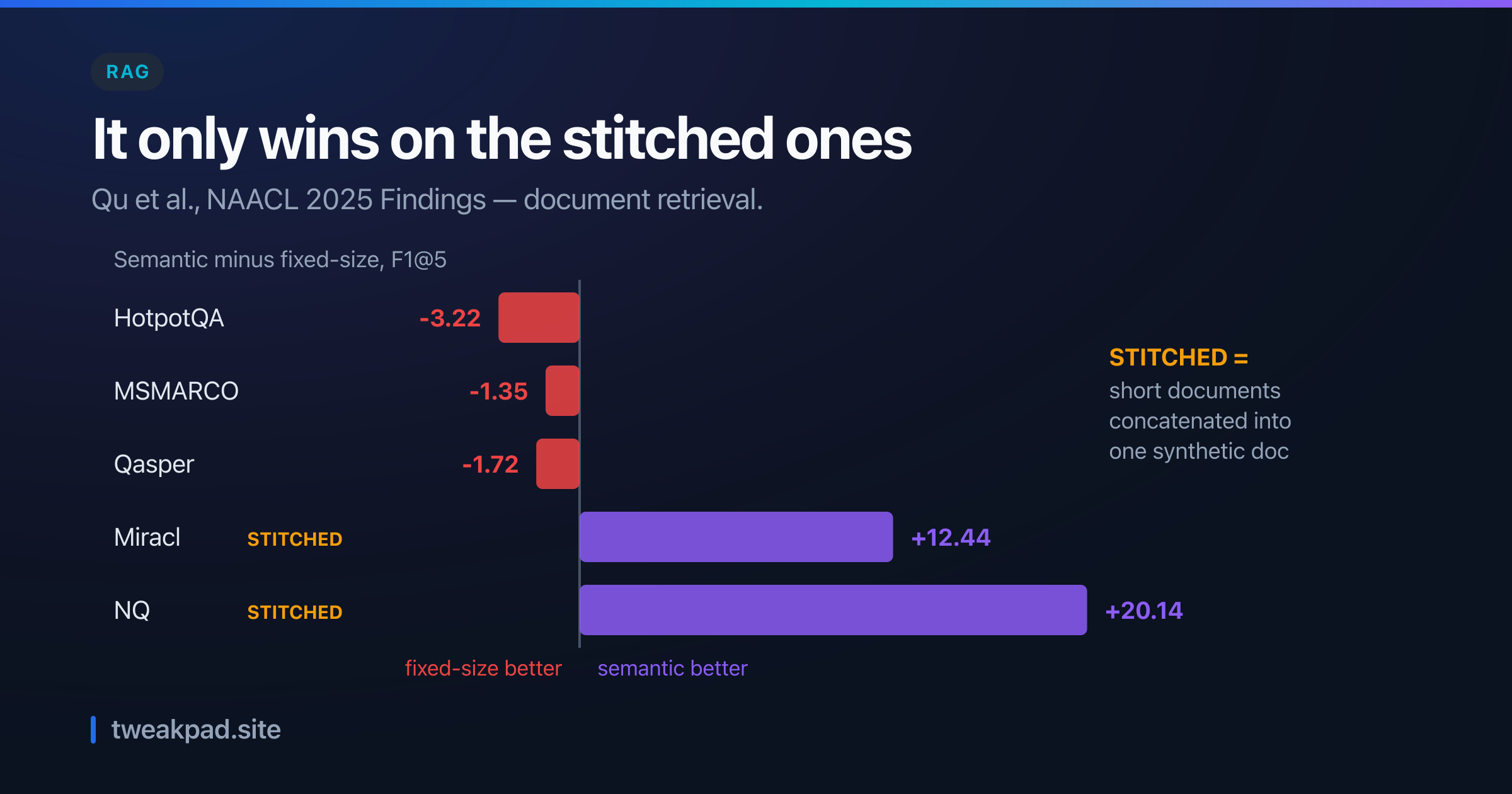
Table of contents
- Key takeaways
- What is semantic chunking, exactly?
- What the study measured
- Where fixed-size won
- The datasets where semantic chunking won
- What semantic chunking costs
- An independent study reached the same place
- A table for the decision
- What size, then?
- The failure mode, and how to detect it
- What semantic chunking genuinely gets right
- Where this advice is wrong
- The short version
Every RAG tutorial recommends semantic chunking. Split on meaning, not on character counts, and retrieval gets better. It sounds obviously right.
A NAACL 2025 paper tested it across three tasks. Fixed-size chunking won on every real-document dataset, and semantic chunking won big on two others. Those two were synthetic.
Key takeaways#
- On real documents, fixed-size beat both semantic methods at document retrieval.
- Semantic chunking won only on stitched datasets, built by gluing unrelated documents together.
- Stitching creates exactly the sharp topic boundaries a breakpoint detector looks for.
- The method costs roughly 11× more embedding calls at index time by construction.
- A second, independent 2026 study found many chunking methods fail on robustness alone.
What is semantic chunking, exactly?#
It splits text where the meaning shifts rather than at a fixed length. The usual method embeds each sentence, measures similarity between neighbours, and cuts where similarity drops. A clustering variant groups related sentences instead. Both aim to keep one idea inside one chunk, so a retrieved chunk arrives whole.
The intuition is sound. The question is whether it pays.
What the study measured#
Qu and colleagues compared three chunkers: a fixed-size baseline, a breakpoint-based semantic chunker, and a clustering-based one. They ran three tasks, covering document retrieval, evidence retrieval and answer generation.
Their abstract states the result without hedging:
The results show that the computational costs associated with semantic chunking are not justified by consistent performance gains.
That is the headline most write-ups quote. The interesting part is which datasets produced which result.
Where fixed-size won#
Start with the datasets made of real documents. These are F1@5 scores for document retrieval, fixed-size first, then breakpoint and clustering.
HotpotQA came in at 90.59 against 87.37 and 84.79. MSMARCO scored 93.58 against 92.23 and 93.18. Qasper reached 90.99 against 89.27 and 90.77.
Fixed-size took all three. The margins are modest, between roughly one and six points, and the direction never wavers.
Evidence retrieval told a duller story still, with the paper reporting minimal differences across methods. So on ordinary documents the choice barely registered, and where it did, the simple method led.
The datasets where semantic chunking won#
Now the two results that go the other way, and they are not close. On Miracl the breakpoint chunker scored 81.89 against fixed-size at 69.45. On NQ it scored 63.93 against 43.79.
That is a 12-point gap and a 20-point gap. If those were the only numbers you saw, the case would look settled.
Read how those datasets were built. The paper made them by concatenating short documents into longer ones of about 100 sentences, because most benchmark documents are too short to chunk meaningfully. Six BEIR datasets got this treatment, Miracl and NQ among them.
So a stitched document is several unrelated documents in a trench coat. It contains hard topic boundaries at the seams, placed there by the construction process.
A breakpoint detector looks for exactly that signal. Give it a document assembled from unrelated parts and it finds the seams, because someone put them there. That is not a finding about chunking. It is a property of the fixture.
What semantic chunking costs#
The paper asserts a computational cost without quantifying it, so here is arithmetic you can check yourself. It follows from how the method works rather than from their measurements.
Take a 100-sentence document that becomes 10 chunks. Fixed-size splits on length, embeds the 10 chunks, and stops. That is 10 embedding calls.
Breakpoint semantic chunking must embed all 100 sentences first, just to find the boundaries, then embed the 10 resulting chunks. That is 110 calls for the same document.
So indexing costs about 11× more embedding calls, and that multiplier holds at any scale. A million documents means 110 million calls instead of 10 million. Re-index after a model change and you pay it again, which is one more reason to treat embedding dimensions and index cost as one budget.
An independent study reached the same place#
A second team, publishing at KES 2026, evaluated a wider set of methods. Their conclusion adds something the first study did not measure.
Our experiments show that chunking in RAG systems is a much more difficult and fragile problem than is often assumed. Many methods fail in practice due to timeouts, memory issues, or poor scalability, and only a subset — Recursive Semantic, Fixed-size, Sequential HAC, Max-min — consistently completes processing across datasets.
Note which method appears in the surviving four. Fixed-size finished everywhere, and most alternatives did not.
Their closing line names the mechanism this article is about:
Only such a comprehensive and standardized comparison will make it possible to answer whether chunking methods have a meaningful impact on RAG quality, or whether observed differences are mainly driven by dataset selection and implementation effects.
Two independent groups, then. One shows the wins concentrated in synthetic data, and the other warns that dataset selection may explain the differences.
A table for the decision#
Semantic chunking is not useless, so here is when I would reach for it, and when I would not.
| Your corpus | Chunker | Why |
|---|---|---|
| Prose articles, docs, wikis | Fixed-size with overlap | Won every real-document test |
| Concatenated or scraped bundles | Semantic | Real seams exist, so a detector finds real signal |
| Structured markup with headings | Split on the headings | Your document already declares its boundaries |
| Transcripts and chat logs | Semantic, measured | Topic shifts are genuine and unmarked |
| Anything, before you measure | Fixed-size | It is the baseline the others must beat |
Row three is the one people skip. If your source has headings, tables or sections, the boundaries are already written down, and inferring them from embeddings is a worse way to read what the document tells you.
The last row is a stance rather than a corpus. Start simple, and make the expensive method prove itself on your data.
What size, then?#
Neither paper prescribes a number, and I am not going to invent one. What they do give you is a way to think about the trade.
A chunk is one point in the vector space. Make it bigger and it covers more text, so its embedding averages more ideas and matches any single query less sharply. Make it smaller and each embedding is crisper, but a complete answer may now span three chunks.
So the two failure directions are dilution and fragmentation. Neither is safe by default, and your documents decide which one bites first.
Overlap trades storage for safety. A 20% overlap means each chunk shares a fifth of its text with its neighbour, which raises the chance one chunk holds a whole idea. It also inflates your index by roughly that fraction, and it duplicates text across neighbours, so a query can match two chunks that say the same thing.
Chunk size also sets your reader budget. If you send the top 5 chunks and each is 500 tokens, that is 2,500 tokens of context. Double the chunk size and the same k doubles the prompt, which pushes you toward the territory covered in retrieving fewer documents.
So tune the pair together rather than separately. Fix your k, sweep chunk size, and measure recall on your own questions. Then adjust overlap only if you see answers split across chunk boundaries, because that is the specific symptom overlap fixes.
The failure mode, and how to detect it#
The trap here is not a crash. It is adopting a technique on evidence that does not transfer, then never checking.
So detection means running the comparison the papers ran, on your own corpus. Build a small evaluation set of real questions with known answer passages, index the same corpus twice, and measure recall at your production k.
Hold everything else fixed. Same embedding model, same k, same reranker, because the first paper found the chunking effect was often smaller than the effect of embedding quality. Change one variable or you learn nothing.
Watch for one specific signal that you are fooling yourself. If semantic chunking wins by a large margin, check whether your documents are concatenations, exports, or scrapes that glued several pages together. A big win is evidence of seams, and seams may mean your ingestion is joining things it should have kept apart.
That check is cheap and it cuts both ways. Either you confirm a real gain, or you find an ingestion bug worth more than the chunker.
What semantic chunking genuinely gets right#
The idea is not wrong, and one framing of it is clearly correct: a chunk that splits a sentence or a table mid-thought retrieves badly. Anyone who has seen a fixed-size window cut through the middle of a code block knows the failure.
Fixed-size chunking with overlap only papers over that. Overlap raises the odds that some chunk holds the whole idea. It buys that by storing the same text twice.
The stitched results also describe a real case rather than an imaginary one. Plenty of production corpora are assembled: a support export with many tickets per file, a scraped page carrying several articles, a PDF concatenating unrelated memos. Those have genuine seams, and a detector will find them.
So semantic chunking solves a document-shape problem. When your documents have that shape, use it. The papers back you up.
There is a third option both studies leave alone, and it often beats either. Markdown, HTML and PDFs with real structure already carry their boundaries as headings and sections. Splitting on those costs one parser and no embeddings, and it reproduces the author's own division of the material. Inferring the same seams from vector similarity is a slower way to learn what the markup already says.
Where this advice is wrong#
One task carried most of the signal. Fixed-size won clearly at document retrieval, while evidence retrieval showed minimal differences between methods. If your pipeline is dominated by evidence selection, the first study gives you weaker grounds than the headline suggests.
Both papers predate the newest embedding models. The first study is from late 2024 and the second from 2026, and embedding quality is exactly the factor the first paper said tends to dominate. A stronger model may change the balance, so treat the numbers as a reason to test rather than a result to inherit.
Fixed-size is not one thing. Chunk size and overlap are parameters, and a badly tuned fixed-size baseline can lose to anything. If you adopt this advice, tune the size and overlap on your own data first, otherwise you are comparing a good semantic chunker to a bad baseline. The same discipline applies to how many chunks you then send, which we covered in retrieving fewer documents.
The short version#
Semantic chunking lost to fixed-size on every real-document retrieval dataset in the NAACL study, and won only on datasets the authors built by stitching unrelated documents together. Stitching manufactures the boundaries a breakpoint detector is designed to find, so the win describes the fixture. Meanwhile the method costs around 11× more embedding calls at index time, and an independent 2026 evaluation found many chunking methods fail on robustness before quality even matters. Start with fixed-size, tune its size and overlap, and reach for semantic chunking when your documents genuinely arrive glued together.
Sources: Qu et al., Is Semantic Chunking Worth the Computational Cost? (arXiv:2410.13070), the same paper in NAACL 2025 Findings, Śmigielski et al., Chunking Methods on Retrieval-Augmented Generation, KES 2026 (arXiv:2606.00881)
Tags
- Rag
- Retrieval
- AI
- Embeddings