Scaled Content Abuse: Google Bans Purpose, Not the Tool
The scaled content abuse policy names purpose and volume, not the tool. What the wording prohibits, and the test that settles it.
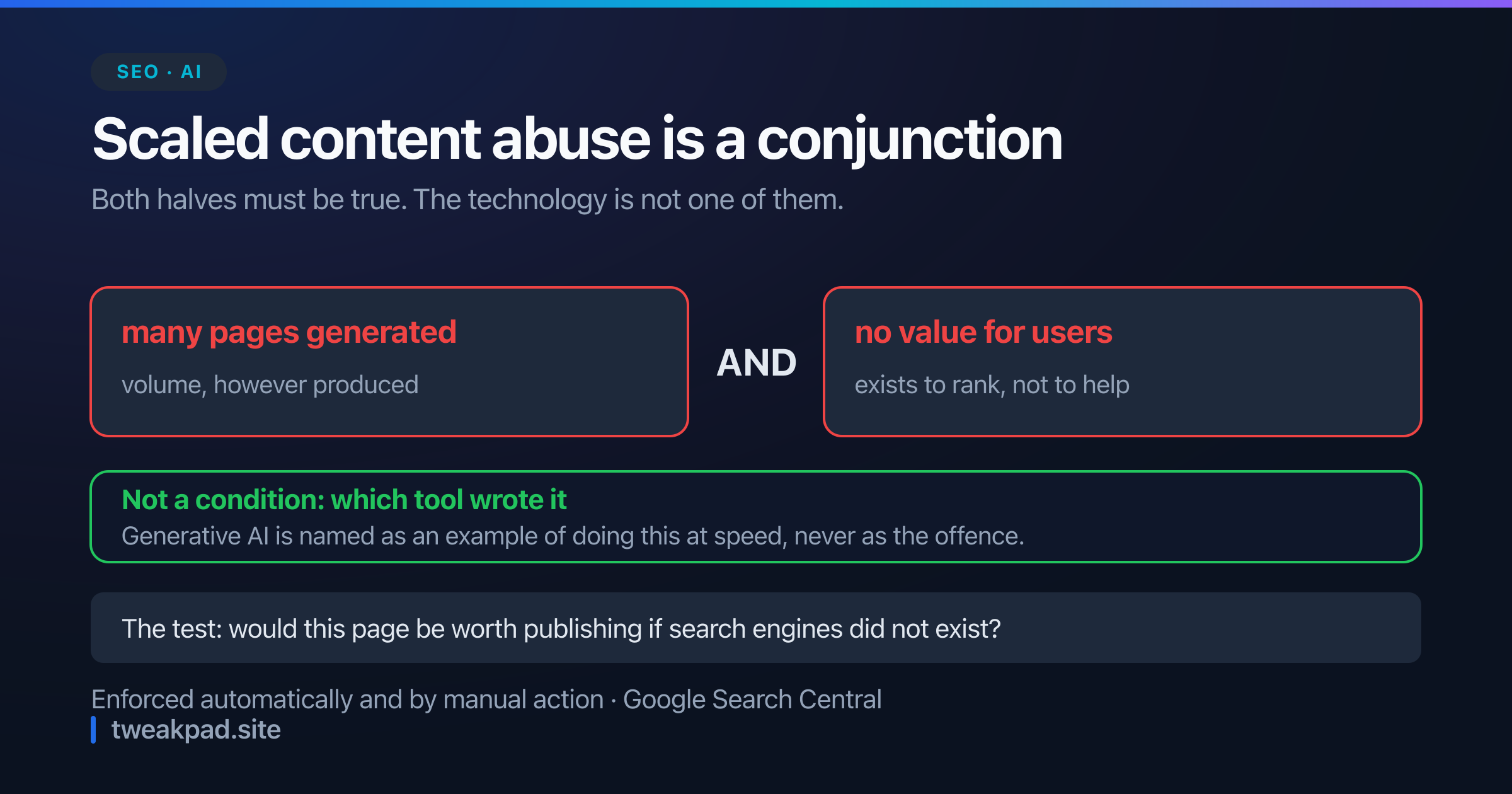
Table of contents
"Google penalises AI content" is repeated constantly and it is not what the policy says. The relevant rule is scaled content abuse, and its wording is careful:
many pages are generated for the primary purpose of manipulating search rankings and not helping users
Two conditions, joined. Volume, and absence of value. The method of production is not one of them.
Key takeaways#
- The policy targets purpose and scale, not the tool. Generative AI is named as an example, not as the violation.
- Both halves must hold. Many pages that help users are fine. One useless page is not scaled abuse.
- Enforcement is automated and manual. A manual action arrives in Search Console; the algorithmic version arrives silently.
- Two related policies catch adjacent behaviour: expired domain abuse and site reputation abuse.
- The practical test is whether the page would be worth publishing if search did not exist.
What scaled content abuse rules in and out#
Read the sentence as a conjunction. The boundary then becomes clear.
Google's own phrasing on the technology runs: "using generative AI tools or other similar tools to generate many pages without adding value for users". The qualifier does the work here. Strip "without adding value" and the sentence bans a category of software. Leave it in, and the sentence bans an outcome instead.
That distinction is deliberate, and Google has stayed consistent about it. The same rule catches a human who writes four hundred templated location pages that differ only by city name. In fact it has caught that behaviour for far longer than generative models have existed.
So a policy reviewer does not ask "did a model write this". Instead they ask a simpler question. Does the page exist because someone wanted a page in the index, or because someone had something to say?
The two adjacent policies#
Scaled content abuse is one of three that tend to be discussed together, and confusing them muddies the advice.
Expired domain abuse covers buying a lapsed domain and repurposing it to exploit its ranking history. Often the new content has nothing to do with what the domain used to be.
Site reputation abuse covers publishing third-party content on an established site mainly to borrow its standing, rather than integrating it for readers. This is the rule behind the coupon and casino sections that appeared on newspaper domains.
All three describe the same underlying move. Each acquires ranking signal without earning it. Scale is the mechanism in the first, domain history in the second, and host reputation in the third.
How enforcement reaches you#
Two paths, and they feel very different.
Automated systems catch most violations, and they work silently. Traffic declines, nothing appears in Search Console, and no notification arrives to appeal. You infer the whole thing from analytics.
A person reviews a manual action, and Search Console does report it. You can file a reconsideration request once you fix the problem. Counterintuitively, then, the manual action is the better outcome, because at least you know.
The consequence in both cases is that a site may rank lower or drop out of results entirely.
A test that is easier to apply than the policy#
Policy language is hard to self-assess against, since everyone believes their own content is valuable. So try a more useful question:
Would this page be worth publishing if search engines did not exist?
If the honest answer is no, then the page exists to be indexed. That is exactly what the policy names. It is a sharper test than word count or a detector score, and it does not care who or what wrote the text.
Three practical corollaries.
Publishing cadence is evidence, not a violation. Nothing prohibits publishing often. But a jump from two articles a month to twenty a day is a visible pattern. The pages had better carry their own weight, because the volume invites the question.
Thin pages at scale are the risk, and templates are the usual culprit. Fifty pages built from one skeleton with a variable swapped are the canonical case, whatever produced them. If a page's only unique content is a name and a number, it is a database row rather than an article.
AI detectors are not the standard. Google has never said it evaluates content that way. Meanwhile the false positive rate on ordinary careful writing runs high enough to make them useless as a check.
What recovery looks like#
Suppose the worst has already happened. The path back differs sharply by enforcement type, and people often attempt the wrong one.
For a manual action, the route is defined. Fix the pages, then file a reconsideration request describing what you changed. A human reads it. Vague requests fail, so name the pages, say what you removed or rewrote, and say why the problem will not recur.
Algorithmic suppression has no such door. No request exists to file, and nothing lifts on a schedule. Recovery arrives when a later crawl finds a genuinely different site, which usually takes months rather than weeks.
Either way, deletion often beats revision. If three hundred pages exist only to rank, rewriting all three hundred is rarely realistic. Removing them and keeping the twenty worth having is faster and more convincing.
What actually helps#
Say something the existing results do not. That is most of it, and you can measure it roughly. If your page repeats the consensus of page one, then it has no reason to outrank page one.
Beyond that, the mundane signals still matter. Copy that repeats a term far more often than a person naturally would reads badly long before it registers anywhere else. The keyword density checker catches that drift quickly. Meanwhile the SEO analyzer covers the structural side, where problems are usually accidents rather than intent.
Neither is a compliance check. Rather, they catch the visible symptoms of writing aimed at an algorithm instead of a reader. That is a decent proxy, though not the same thing.
The short version#
The policy bans generating many pages whose primary purpose is ranking rather than helping, and it says so in those words. It lists generative tools as one way to do that at speed, not as the offence itself. So publish because you have something to add. Keep templated near-duplicates out of the index. And treat any sudden jump in cadence as something the pages themselves have to justify.
Sources: Google Search Central: Spam policies for Google web search
Tags
- SEO
- AI
- Content